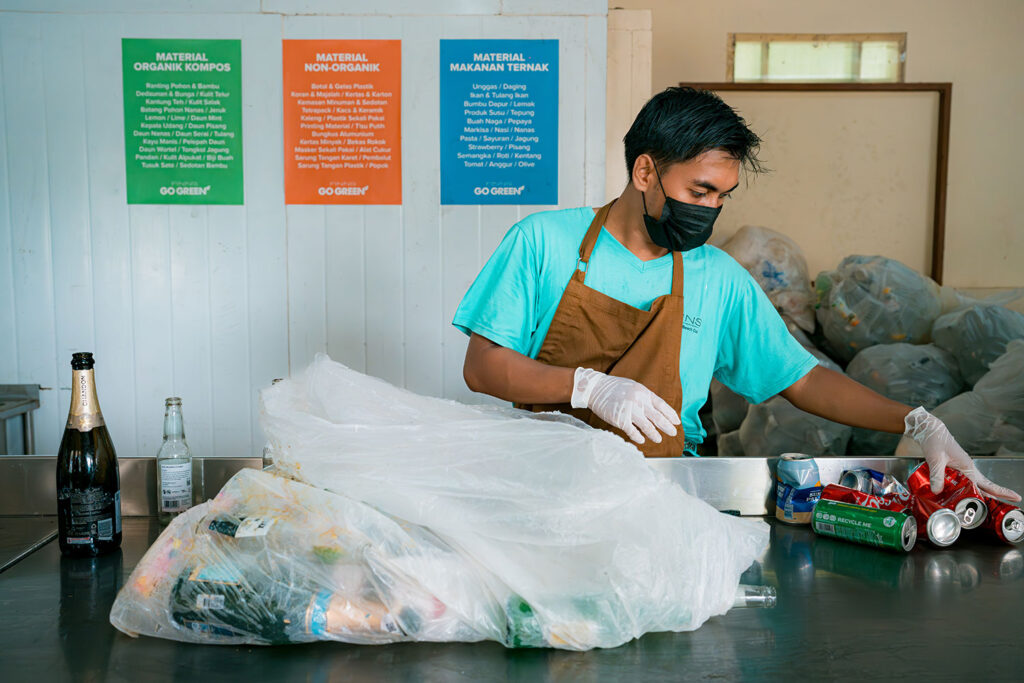
Bali’s tourism boom has been both a blessing and a curse for the beautiful tropical island. The economy is thriving, but the environmental pressures that come with that are mounting.
In 2025, local government figures show that 7.1 million international visitors and 26.6 million domestic visitors arrived on the island. That’s roughly 8 visitors for every local resident!
The bad news is that not only does this put obvious strain on local resources, but visitors seem to generate 3.5 times as much plastic waste as residents do. Single-use plastics, inadequate waste infrastructure, poor education regarding waste for both locals and tourists, and overtourism have led to serious problems in rivers, resorts and landfills.
Yet, amid these growing challenges, a powerful shift is taking place in Bali’s hospitality industry. Forward-thinking hotels, resorts, villas and industry leaders are pioneering plastic-free and zero-waste initiatives that are not only mitigating the damage of tourism but helping to redefine luxury hospitality in this most iconic holiday destination.
This transformation is occurring because of regulatory pressure, guest demand for authentic sustainability efforts rather than “greenwashing”, and the local respect for Tri Hita Karana (the Balinese-Hindu philosophy that demands balance between people, nature and the divine).
So, let’s take a closer look at the drivers, standout examples, practical strategies, benefits and challenges on the road ahead for zero-waste hospitality in Bali.
The Plastic Crisis In Bali’s Paradise
Bali’s waste problems are very well-documented. Plastic pollution clogs rivers and waterfalls, it litters beaches, marine life is under threat, and of course, it impacts tourism appeal. Government responses have intensified, though they have not always come to fruition.
While the ban on single-use plastics in government offices and schools was successful, a well-publicised ban on plastic bottles under 1 litre in volume has seemingly sunk due to logistical problems and an ambitious “Clean Waste from Bali” program that aims for the island to be waste-free by 2027 seems highly unlikely to deliver the expected results.
However, star-rated hotels have been given new mandates to upgrade their waste management, and there are potential sanctions for non-compliance. Grassroots efforts such as those by the well-known Sungai Watch (which has installed river barriers and conducted large-scale plastic cleanups) and partnerships with NGOs help to complement these efforts and policies.
Hospitality is a cornerstone of the island’s economy; in fact, they estimate that 90% of all money in the island’s economy is generated by tourism either directly or indirectly. This means that it bears significant responsibility for the environmental issues Bali faces, and there is a significant opportunity if the industry resolves these problems.
Initiatives such as Destination Zero Waste Bali, a project launched in May 2025 by Enviu, Tui Care Foundation and the Global Tourism Plastics Initiative (GTPI) help to target this head-on by assessing the use of plastic in hotels and piloting solutions which can be rapidly scaled once implemented and the benefits become clear.
Participating properties in this project include Nirjhara, Raffles Bali, Segara Village, and Tony’s Villa and Resort. This project emphasises prevention, reuse, refill systems and circular economic principles. It also provides training for stakeholders and community members.
Leading The Charge: Exemplary Hotels And Resorts In The Zero Waste Scene
There are several properties that stand out in this arena as pioneers that have proven that zero waste can enhance, as opposed to compromise, their guests’ experiences.
Desa Potato Head (Seminyak)
It’s fair to say that Desa Potato Head is a flagship example of circular creativity. Since committing to zero waste principles, after their founder Ronald Akili found himself surrounded by plastic during an ocean surfing session, the resort has achieved an astonishing 97.5% diversion from landfill (in fact, recent audits show that they may have as little as 0.5% of their waste going to landfills). They are still working towards the ambitious goal of true zero.
The “Waste Lab” (which is housed inside a striking bamboo “womb”) helps to upcycle plastics they collect from rivers into terrazzo panels, furniture (e.g. chairs by Max Lamb), jewellery and other amenities.
Oyster shells and styrofoam make colourful kits, and used cooking oil is converted into candles, etc.
Their guests are able to participate in workshops, “Follow the Waste” tours and even join beach workouts that incorporate trash collection. Architecture and design in the resort all feature reclaimed materials where possible (they use over 1.8 million hand-pressed bricks, and many furnishings are recycled plastics).
There are no accusations of greenwashing around Desa Potato Head; it’s a fully holistic and regenerative model that includes community waste projects that are expanding island-wide.
Alila Villas Uluwatu
Alila has long championed a Zero Waste to Landfill policy, and they have an on-site Sustainability Lab which works out of repurposed shipping containers.
They’ve completely eliminated the use of single-use plastics across their resort, and waste streams are also meticulously sorted. Old slippers become beanbag filler, toilet paper rolls go to recycling partners such as the R.O.L.E. foundation, tyres are made into playground equipment and planters (or go to Indosole for sandal making), and their glass is repurposed into new drinkware.
Their organic gardens supply their kitchens, their compost feeds the permaculture, and reverse osmosis helps them produce glass-bottled water on site. Their guests are asked to join tours and hands-on experiences such as sambal-making to help turn sustainability into an opportunity for creating memories and storytelling.
Alila’s approach is also being replicated in other properties across the management team’s portfolio.
Buahan, A Banyan Tree Escape
This luxury resort has a “no waste” philosophy for its jungle setting just North of Ubud. It has open-air villas, hyper-local sourcing (90% of all produce is purchased locally within a small radius of the property), its kitchen minimises what it discards; so veggie scraps might be converted to kombucha or umami powder, fish parts are used for garum, and overripe fruit fuels desserts.
Their nearly 100% plastic-free kitchen and community farm integration showcase regenerative luxury,
Other notable resorts include Six Senses Uluwatu, which reached 78% zero-waste implementation with strong organic farming and waste tracking, and smaller eco-resorts like Bambu Indah or properties in their growing network of plastic-free villas.
Practical Strategies For Plastic-Free And Zero-Waste Operations In Bali
Successful initiatives have many common pillars, including:
- The elimination of single-use plastics – switching to glass/stainless steel water bottles (and offering on-site refill stations and purification), banning straws/cutlery/toiletries that use plastic, and auditing supply chains to reject plastic-wrapped deliveries.
- Robust sorting and on-site processing – the use of dedicated waste stations, staff training, labs/facilities for composting organics, implementation of upcycling and recycling partnerships. Technologies like plastic-to-diesel convertors and Integrated Sustainable Resource Recovery Facilities (iSuRRF) are emerging.
- Circular design and amenities – using biodegradable or upcycled materials (think coconut husk slippers or reclaimed wood or fabrics). Partnering with local artisans for custom-made products.
- Guest engagement – providing educational tours, workshops, apps that track personal impact, and offering incentives for sustainable behaviour (e.g. discounts for using sustainable mugs or bottles).
- Food waste reduction – think farm-to-table programs with on-site gardens, nose-to-tail and root-to-stem cooking, composting, and animal-feed partnerships.
- Community and supply chain collaboration – supporting local waste banks, training suppliers, educating the local community and joining initiatives like Destination Zero Waste Bali.
- Measurement and certification – using GTPI (Global Tourism Plastics Initiative) for auditing plastic use, tracking diversion rates, using blockchain technology for clear audit trails, and pursuing certifications such as EarthCheck, GreenGlobe, etc.
The Business Benefits: Why Zero-Waste Makes Sense In Bali
There are real benefits to zero-waste; this isn’t eco-friendliness for its own sake; it’s because there are measurable positive impacts for businesses that pursue these opportunities:
- The environmental impact – reducing pollution preserves coral reefs, mangroves and biodiversity, which are core to the tourism appeal of Bali. Lower carbon footprints result from less transport of waste and virgin materials (which not only benefit the environment but also save on costs).
- Guest appeal and loyalty – Millennials and Gen Z travellers, in particular, tend to be eco-conscious, and they seek out verifiably sustainable properties. Then they leave positive reviews and talk about their experiences, which help to drive future bookings. Properties like Alila and Potato Head can differentiate their offerings from other luxury properties by the use of authentic storytelling and experiences.
- Cost savings – while there’s no doubt that initial implementation costs can be steep, in the long-term there are reductions in waste disposal costs, water/energy usage, and purchasing (refills are much cheaper to service than disposable items). Upcycling can even create new revenue streams, such as selling the products and designs that come from it.
- Regulatory compliance and reputational gains – these approaches also help to avoid fines, attract investment and align with government regulations and goals. Strong ESG (Environmental and Social Governance) approaches enhance local partnerships with international tour operators.
- Cultural and social good – these approaches also help to empower local communities by providing jobs in upcycling and recycling; they also work to preserve the Subak system (Bali’s only UNESCO World Heritage site) and the traditions of that system, and educate tourists.
Challenges And Realistic Hurdles
Let’s not pretend that transitioning to a zero-waste, plastic-free environment is seamless. It’s expensive to get going thanks to high upfront costs for infrastructure and training.
There are limited local recycling facilities and capacity, the supply chain in Bali is inconsistent at best, and there is even some guest resistance (many guests still demand the convenience of plastic).
Bali’s tropical climate helps to accelerate waste decomposition, but it complicates storage. Smaller independent hotels often lack resources when compared to the multinational chains, though programs like Destination Zero Waste aim to help bridge that gap.
Maintaining luxury standards while going plastic-free requires genuine creativity. For example, replacing single-use toiletries with dispensers or refillable luxury options without compromising hygiene perceptions with guests. Staff turnover in this industry also means non-stop ongoing education.
Most of all, success requires real buy-in from leadership, phased and planned implementation that scales as required, and collaboration throughout the whole business ecosystem; it can’t be sustained by resorts alone.
Final Thoughts: The Future Is Moving Towards Regenerative Hospitality In Bali
By 2027 and looking beyond, we expect to see wider adoption of refill ecosystems, advanced upcycling technology, AI-optimised waste tracking, and deeper integration with regenerative agriculture and community enterprises in Bali.
As travellers, it’s easy to support these initiatives. Choose certified eco-properties, use reusable materials whenever possible, participate in green activities, and respect local customs. As industry professionals, we need to measure, iterate and share our knowledge.
The hospitality industry in Bali isn’t just adapting; it’s innovating. Luxury and planetary health are inseparable. Properties that embrace plastic-free and zero-waste won’t sacrifice appeal; they enhance it and create deeper connections to place and purpose.
Bali’s beauty is legendary. Its resilience, however, depends on collective action. The initiatives reshaping hospitality on the island today will define the future. It needs to be a cleaner, greener paradise for generations to come.
Why not take a look at our guide to building lasting memories in Bali and our tips for temple etiquette too?